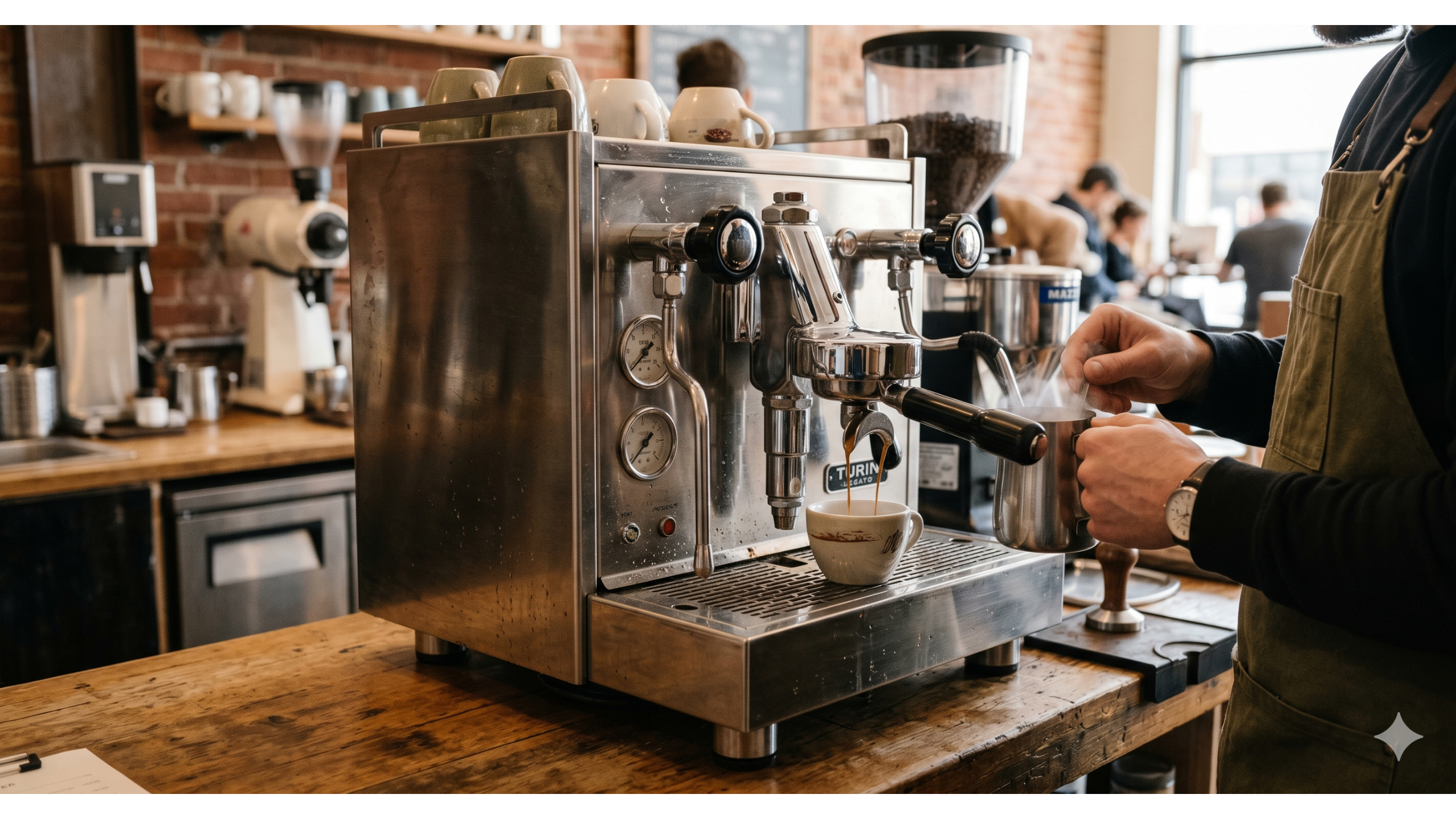
Key Takeaways
- The Turin Legato V2 delivers professional features — dual PIDs, externally adjustable OPV, flow control, and a 550ml stainless steel boiler — at approximately $479 on Amazon at time of writing, undercutting machines with comparable specs by hundreds of dollars. [Prices fluctuate — verify current pricing before purchasing].
- Its hybrid heating system eliminates the sequential workflow that defines every single-boiler machine, including the updated Gaggia Classic Pro E24, allowing simultaneous brewing and steaming without a temperature transition wait
- The Gaggia Classic Pro E24 is a genuinely improved machine — its 2024 brass boiler upgrade resolved the Boilergate coating controversy and delivers better thermal stability than any prior Classic — but it remains a single-boiler design with a bimetallic thermostat, and those architectural limits haven’t changed
- Where the E24 requires timing, patience, and technique to extract consistently, the Turin’s dual PID controllers deliver set-and-forget temperature precision that removes the guesswork entirely
- Despite impressive specs, the Turin Legato V2 carries real trade-offs: a 15-20 minute heat-soak requirement, developing community support compared to the Gaggia’s 30-year ecosystem, and no long-term durability track record, that buyers should understand before committing
The sub-$500 espresso market has always forced a choice: accept an appliance-grade feature set, or buy a legacy design that rewards modification. The Turin Legato V2 challenges that premise by packing a specification sheet that reads like machines costing twice as much — and doing it at a price that leaves room in the budget for a serious grinder.
Gaggia hasn’t stood still, either. The 2024 Classic Pro E24 represents the most significant update to the Classic line in years, trading the aluminium boiler for a lead-free brass design that delivers genuine improvements in thermal stability and steam performance. This is a better machine than anything the Classic nameplate has previously offered.
The honest question isn’t which brand is superior. It’s which architecture matches how you actually make coffee. This review lays out exactly where the Legato V2 wins, where the E24 wins, and where the decision genuinely comes down to your workflow and priorities.
If you’re still mapping the sub-$1,000 market before committing, our complete guide to espresso machines under $1,000 covers every serious option at this price point and gives you a framework for understanding where both machines sit relative to the broader field.
Head-to-Head: Turin Legato V2 vs Gaggia Classic Pro E24
The comparison below breaks down the Turin Legato V2 against the Gaggia Classic Pro E24 across the six factors that matter most to home baristas making a serious upgrade decision.
1. Temperature Control
Turin Legato V2
Dual PID controllers maintain programmable brew temperature between 85°C-102°C in single-degree increments. Set-and-forget precision — no timing rituals, no guesswork. The second PID governs the steam thermoblock independently, keeping both zones dialled in without compromise. (✓ ADVANTAGE)
Gaggia Classic Pro E24
The E24’s brass boiler is a genuine improvement — its greater thermal mass narrows the bimetallic thermostat’s temperature swing from roughly 7°F on aluminium models to around 3°F. That makes the E24 more forgiving than any previous Classic. But there is no PID. The thermostat still cycles, and for optimal, repeatable results, temperature surfing, remains the technique-conscious owner’s standard practice. (⚠ LIMITATION)
2. Boiler Architecture
Turin Legato V2
550ml stainless steel brew boiler acts as a thermal battery — replacing the 36ml used in a double shot represents less than 7% of total volume, so thermal stability holds throughout the pull rather than degrading as the shot progresses. (✓ ADVANTAGE)
Gaggia Classic Pro E24
The 2024 brass boiler upgrade is meaningful. Brass has more thermal mass than aluminium, the internal capacity is approximately 25% larger, and the Boilergate coating controversy is permanently resolved. Steam power and consecutive-drink performance have both improved. (⚠ TRADE OFF)
3. Pressure Management
Turin Legato V2
Externally adjustable OPV — dial in 9-bar extraction pressure in seconds using the included blind basket and a thumbscrew. (✓ ADVANTAGE)
Gaggia Classic Pro E24
North American E24 units ship with a factory-set 9-bar OPV — a genuine improvement over older Classic models that required internal modification to achieve correct pressure. (⚠ LIMITATION)
4. Workflow & Steam
Turin Legato V2
Dedicated steam thermoblock allows simultaneous brewing and steaming — pull a shot and texture milk without any temperature transition wait. This workflow capability is normally reserved for dual-boiler machines costing significantly more. (✓ ADVANTAGE)
Gaggia Classic Pro E24
Single-boiler architecture still requires a sequential workflow. Brew first, then engage the steam switch and wait while the boiler climbs from brew temperature to steam temperature — typically 30 to 60 seconds on the E24’s faster-heating brass boiler. (⚠ LIMITATION)
5. Startup & Convenience
Turin Legato V2
15-20 minutes of full heat-soak required for optimal performance. The 550ml boiler reaches PID target temperature within a few minutes, but the group head assembly needs passive heating time to reach true thermal equilibrium. (⚠ TRADE-OFF)
Gaggia Classic Pro E24
Reaches brew-ready indication in 71-90 seconds. Full group head stabilisation still benefits from 10-15 minutes with the portafilter locked in — similar caution applies to any thermally sensitive single boiler — but the E24 is genuinely quicker to usable temperature than the Legato. (✓ ADVANTAGE)
6. Value at Price Point (~$479 vs ~$479-549)
Turin Legato V2
At approximately $479 on Amazon, the Legato V2 currently prices below or at parity with the E24 depending on colorway — and delivers dual PIDs, external OPV adjustment, flow control, pre-infusion delay, and a 550ml stainless boiler that are standard features on machines costing $800-1,200+. (✓ ADVANTAGE)
Gaggia Classic Pro E24
At approximately $499-549, the E24 is no longer the clear price winner it once was when compared against legacy stock. (⚠ CONTEXT)
Above comparison based on factory-stock configurations. Prices fluctuate, verify current pricing before purchasing.
The six categories above capture the performance fundamentals. The right machine ultimately comes down to one question: do you want the workflow efficiency and extraction precision the Legato V2 delivers at the factory price — or do you value the heritage, repairability, and community depth that thirty years of the Gaggia Classic ecosystem provides? Neither answer is wrong, but they lead to different machines.
Professional Features at Half the Price
The Turin Legato V2 represents a genuine market disruption in the sub-$500 category. Traditionally, this price bracket meant accepting pressurised portafilters, volatile thermoblock heating, and fixed high-bar pump pressure that fractured coffee pucks and created channelling when used with specialty coffee in unpressurised baskets. The Legato V2 dismantles these limitations with a specification sheet that reads like machines costing significantly more.
At its core sits a 550ml stainless steel brew boiler — substantial thermal mass that provides rock-steady temperature stability during extraction. This isn’t the compact boiler found in entry-level competitors that loses temperature the moment cold water enters. Replacing 36ml of water during a double shot represents less than 7% of total capacity, meaning the thermal battery effect holds throughout the pull rather than degrading as the shot progresses.
The machine’s dual PID controllers offer precision in this price category that simply did not exist before. Turin’s product documentation confirms these digital controllers maintain user-programmable temperatures between 85°C and 102°C in single-degree increments — a range that covers everything from dark espresso blends to high-extraction light roasts. No temperature surfing, no timing rituals — dial in the temperature and pull consistent shots.
The Hidden Truth About Dual PIDs
The dual PID system in the Turin Legato V2 operates on a fundamentally different level than any single-controller machine. While one PID manages the 550ml brew boiler, the second controller governs an independent thermoblock dedicated solely to steam generation. This separation eliminates the thermal bottleneck inherent in every single-boiler design, including the improved E24.
On any single-boiler machine, both brewing and steaming compete for the same thermal resource. The Gaggia E24’s brass boiler is a genuine upgrade, delivering narrower temperature variance and more steam power than prior Classic models. But the fundamental constraint is unchanged: one boiler, one temperature at a time, one transition wait every time you switch between functions. The Legato’s dual architecture removes that constraint entirely.
550ml Stainless Steel Brew Boiler vs Gaggia’s Brass Upgrade
It’s worth acknowledging what the E24’s brass boiler actually delivers, because it’s a real improvement and comparisons that ignore it lose credibility. The brass boiler has approximately 25% more capacity than the aluminium design it replaced, stores more heat due to brass’s greater thermal mass, and delivers measurably better consecutive-drink performance. Testing by Whole Latte Love confirms the E24’s brass boiler retains heat more consistently under load, its temperature variance narrows to roughly 3°F across a thermostat cycle versus the 7°F documented on aluminium models.
That said, the thermal advantage reveals itself mid-extraction when you compare the architectures directly. The Legato’s 550ml stainless boiler absorbs the 36ml of cold replacement water during a double shot with barely a measurable thermal shift — that 36ml represents less than 7% of total volume. The E24’s improved boiler, while meaningfully better than its predecessor, works with a fraction of that thermal mass. The physics still play out in the Legato’s favour at extraction temperature, shot after shot.
Independent Steam Thermoblock Eliminates Wait Times
The hybrid heating architecture allows simultaneous brewing and steaming, a workflow advantage that single-boiler machines cannot replicate regardless of their boiler quality. The dedicated steam thermoblock flash-heats water on demand, producing microfoam suitable for latte art without disrupting the brew boiler’s temperature stability. Users can pull espresso shots and steam milk back-to-back without any temperature recovery period.
Physics still imposes limitations. Operating on standard 120V household current with a 1500W maximum draw, the steam output delivers capable milk texturing rather than the aggressive velocity of commercial machines with dedicated large-volume steam boilers. In real-world use — steaming 150-170ml of milk to 60°C — expect times in the 35-45 second range. For home use, including entertaining, this is more than adequate. For volume comparable to a busy café, it is not the right tool.
Why the Adjustable OPV Changes Everything
The externally adjustable over-pressure valve remains one of the V2’s most significant practical advances. Standard vibratory pumps generate 15-bar pressure, a force that fractures coffee beds and causes channelling when used with specialty coffee in unpressurised baskets. The industry standard for extraction is 9-bar, allowing water to gently compress the coffee while extracting soluble compounds without destroying puck integrity.
9-Bar Precision Without Machine Surgery
Unlike machines requiring internal access to dial in pressure, the Legato V2’s OPV adjustment takes under a minute using the included blind basket. Engage the pump, monitor the integrated pressure gauge, turn the external thumbscrew. No disassembly, no warranty complications, no specialist tools. This accessibility matters because pressure calibration isn’t a one-time setup — different baskets and coffee styles respond differently, and being able to adjust in seconds rather than pulling the machine apart changes how willing you are to experiment.
The Gaggia E24 ships with a factory-set 9-bar OPV for North American buyers, which eliminates the modification that prior Classic owners performed as a matter of routine. This is a genuine improvement. The distinction is accessibility: the E24’s OPV is internal, the Legato’s is external. For buyers who want factory-correct pressure and never intend to change it, the E24 delivers. For buyers who want to explore the impact of pressure on different extractions, the Legato’s external control is meaningfully more usable.
Manual Flow Control for Specialty Coffee
Beyond pressure control, the V2 includes a manual flow restriction dial that governs water delivery rate to the group head. Reducing flow creates a gentler pressure ramp-up during initial saturation, protecting delicate coffee bed structure — particularly valuable for lighter roasts where the puck is less dense and more susceptible to channelling. The pre-infusion delay setting further allows users to calibrate how long the machine wets the grounds before full pressure engages. In practice, the pre-infusion duration itself is fixed by the machine’s design; it’s the delay before full pressure that’s adjustable. Within those constraints, the level of extraction control available at this price remains genuinely uncommon.
The Gaggia Classic Pro E24: Credit Where It’s Due
Any honest review of this comparison needs to say plainly what the Gaggia Classic Pro E24 has that the Legato does not.
The Gaggia Classic has been in continuous production since 1991. That means three decades of community knowledge, repair guides, modification tutorials, and specialist parts availability. If your E24 needs a new gasket, a thermostat, a solenoid, or a steam wand tip in five years, you will find it within minutes on Home-Barista.com, Reddit, or Amazon. The Turin Legato V2 is approximately two years old. Its community is growing quickly and the machine’s basic serviceability is reasonable, but it has no long-term track record and no equivalent specialist ecosystem. That gap matters for buyers thinking beyond the first year of ownership.
The E24 is also made in Italy. That heritage carries tangible and intangible value: tighter manufacturing tolerances on some components, a brand with a verifiable 80-year history, and the trust that comes from a machine that has earned its reputation rather than asserted it.
Finally, the E24’s brass boiler and factory 9-bar OPV genuinely improve on the frustrations that defined earlier Classic models. If you own a 2019 Classic Pro, the E24 is a meaningful upgrade. If you were put off the Classic line by the 2023 Boilergate coating issue, the E24 resolves that permanently, Gaggia pivoted to the brass boiler design in response and has not looked back.
What the E24 does not resolve is its single-boiler architecture, the absence of PID temperature control, and the sequential brew-to-steam workflow that results from both. Those are architectural constraints that no boiler material upgrade changes.
What Turin Doesn’t Want You to Know
Despite its impressive specification sheet, the Turin Legato V2 carries design trade-offs that buyers should understand before purchase. These are real considerations, not marketing noise.
Drip Tray Clearance
The drip tray presents the most commonly cited ergonomic frustration among Legato owners. Limited vertical clearance between the portafilter and drip grate makes accommodating both a precision scale and larger cups during extraction difficult or impossible with the stock tray. Modern espresso workflow increasingly relies on real-time weight measurement, and the original tray geometry works against this. A custom low-profile drip tray — available from several aftermarket suppliers in PETG or stainless steel, typically $30-50 — lowers the platform by approximately 15mm and resolves the issue. Requiring an accessory purchase to achieve comfortable workflow is a legitimate design criticism.
Full Heat-Soaking Takes 15-20 Minutes
The thermal mass that makes the Legato’s brew temperature so stable also demands patience at startup. Turin’s own product documentation recommends allowing at least 15-20 minutes before pulling the first shot to ensure the group head is fully saturated with heat. Pull too early and the cold brass group assembly draws heat from the brew water, producing under-extracted results that the PID readout gives no warning of — it shows boiler temperature, not group head temperature. The Legato rewards a scheduled routine. For anyone who wants espresso in two minutes after rolling out of bed, this machine will frustrate. Paired with a smart plug on a timer, the heat-soak becomes invisible.
Internal PCB Exposure
Disassembly of the Legato reveals a main logic board positioned vertically without waterproof housing, close to high-pressure water lines and steam components. Several specialist reviewers including CoffeeGeek and the Coffeeblog UK Apex V2 review (which shares the same base machine) have noted this as a potential long-term reliability concern under the thermal cycling and vibration a working espresso machine experiences. Whether this concern materialises into failure rates higher than other machines in this class remains unknown — the machine is too new for that data to exist. It is a design choice to be aware of, particularly when comparing against a machine with a 30-year serviceability track record.
Steam Output Is Capable, Not Commercial
The Legato’s steam performs well for home use — steaming 150-170ml of milk for flat whites and cappuccinos, creating microfoam suitable for basic latte art. It is not a commercial steam boiler. Steaming times in the 35-45 second range for a standard milk drink are longer than a dedicated steam boiler would achieve. For home use this is a non-issue. For anyone making three or four milk drinks consecutively, the difference in pace is noticeable.
The Sub-$500 Machine That Outperforms More Expensive Competitors
The Turin Legato V2’s true disruption is not that it beats a specific competitor — it’s that it changes the floor for what sub-$500 machines are expected to deliver. Dual PIDs, factory-correct pressure, simultaneous brew-and-steam capability, and a 58mm commercial portafilter ecosystem are now available at a price that leaves budget for a serious grinder. Machines that offered this feature set a few years ago cost $800-1,200.
The Gaggia Classic Pro E24 is the best version of the Classic that Gaggia has ever produced. Its brass boiler is a genuine improvement, its factory pressure is correct for North American buyers, and its 30-year community ecosystem remains unmatched. It is also an Italian-made machine with a proven durability record — something the Turin Legato V2 simply cannot claim at two years old.
For baristas who value temperature surfing as craft, enjoy the modification ecosystem, want Italian provenance, or are buying for the long haul with full awareness of the support available — the E24 is still an excellent machine at its price.
For baristas who want out-of-the-box dual PID precision, simultaneous brew-and-steam capability, external pressure adjustment, and a 550ml thermally stable brew boiler without modifying anything or waiting for the right moment in a heating cycle — the Turin Legato V2 delivers all of it at approximately $479 on Amazon. That it now prices below or at parity with the E24 makes the case straightforwardly.
For detailed buying guides across every espresso machine category and price tier, visit BrewPrecision, built to help home coffee enthusiasts choose the right machine with confidence.
BrewPrecision
Building 148741
PO Box 7169
Poole
England
BH15 9EL
United Kingdom