
Key Takeaways
- Selling vinyl records involves significant physical demands at every stage – sourcing, grading, storing, packing, and posting – that many disabled people cannot reliably meet.
- There is an important difference between selling a collection you already own (a one-time activity) and building an ongoing resale business (which requires repeated physical effort and upfront money).
- UK benefits rules – including ESA Permitted Work limits and Universal Credit tapers – must be understood before earning a single penny, not after.
- For disabled beginners, vinyl reselling scores around 5 out of 10 for realistic viability – and digital alternatives like the approach outlined by Confidence Reclaim remove most of the physical barriers entirely.
- Fluctuating health makes fulfilment – the stage where a buyer is already waiting – the hardest part to manage consistently.
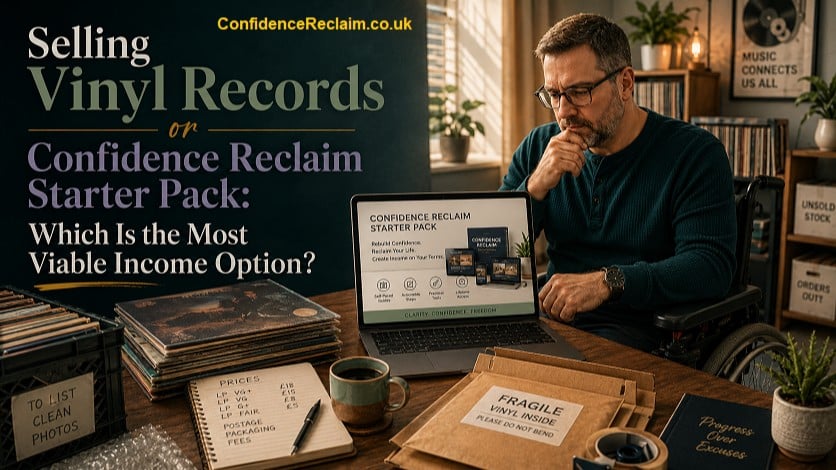
Vinyl records have had a genuine resurgence. The market is real, the demand is real, and the appeal of turning a crate of old records into extra income is completely understandable. But for disabled people managing health limitations, the question is never simply can money be made – the real question is can this realistically be done around my life? For most disabled beginners, the honest answer is more complicated than it first appears.
Vinyl Selling Sounds Flexible – The Reality Is More Physical Than It Appears
The idea sounds appealing on paper: work from home, set your own hours, sell things people actually want. The reality is that vinyl selling is only partly a home-based activity. Listing and researching can happen from a sofa. Sourcing stock, carrying boxes, cleaning records, packing orders, and visiting a post office cannot.
At every stage – from finding the records to getting them into a buyer’s hands – there is a physical demand. For someone with a stable condition and plenty of storage space, those demands may be manageable. For someone living with chronic pain, fatigue, or unpredictable symptoms, each stage becomes a potential barrier. The cumulative weight of those barriers is what makes vinyl reselling a less realistic starting point than it initially seems.
Two Very Different Activities Often Get Confused
Before going further, it is worth separating two things that are often treated as identical.
Selling a Collection You Already Own
If records are already sitting at home – inherited, collected over the years, or simply no longer used – selling them is a reasonable way to convert an asset into cash. There is no need to source new stock, no money tied up before the first sale, and the activity can be paced to suit available energy. The catch is that once the collection is sold, the income stops. This is better understood as a one-time clearance than a sustainable income stream.
Buying Vinyl Repeatedly to Resell
An ongoing resale business works very differently. Stock must be found cheap enough to leave a profit after fees, postage, and packaging – from charity shops, car boot sales, record fairs, or online auctions. The records that are easiest to find are rarely the ones buyers want. Desirable pressings attract competition from experienced sellers who already know where to look. Building a reliable supply of worthwhile stock is harder than most beginners expect, and that difficulty exists before the physical demands of the work even come into the picture.
Every Stage Has a Physical Demand
Sourcing, Grading and Cleaning
Sourcing alone may involve travel to charity shops, carrying heavy bags, and searching through crates of records. Grading requires close visual inspection – checking for scratches, warping, and sleeve damage – and accuracy matters, because a buyer who disagrees with a description can request a refund. Different editions of the same album can have dramatically different values, meaning catalogue numbers, matrix etchings, and pressing details all need checking. Visual impairments, difficulties concentrating, or conditions affecting fine motor control can make this stage particularly demanding. Records often need cleaning before listing too, adding another step before a single photograph has been taken.
Storage, Packing and Posting
Vinyl is bulky and fragile. An active resale operation needs space for unsold stock, packaging materials, cleaning equipment, and orders waiting to go out. In a smaller home – or one where mobility equipment already occupies floor space – this creates a practical problem that cannot be solved digitally. Packing requires handling heavy, breakable items with precision, and then those items need to reach a post office or collection point. For someone with limited mobility or restricted transport access, that final step can quietly become the biggest obstacle of all.
Fluctuating Health Makes Fulfilment the Hardest Part
Research and listing can be paused. A buyer waiting for an order cannot be.
The moment a sale is confirmed, the activity becomes time-sensitive. The record must be located, packed, and dispatched within the promised window. For someone with a fluctuating condition – where capacity on any given day is genuinely unpredictable – this is where the model starts to break down. A flare-up on the day an order needs to go out is not a hypothetical risk. It is an entirely realistic scenario that can lead to negative feedback, disputes, and customer-service pressure that adds stress rather than income.
Who Vinyl Selling Might Actually Suit
Realistic Fit Checklist
Vinyl reselling is genuinely viable for some people. It may suit someone who:
- Already owns a worthwhile collection and wants a one-time sale
- Has detailed knowledge of artists, labels, or collectible pressings
- Has suitable storage space and can manage packing comfortably
- Has reliable access to affordable stock through existing channels
- Can manage customer communication and dispatch consistently
- Is comfortable with irregular income and money occasionally tied up in unsold items
Where It Breaks Down for Many Disabled Beginners
For those who do not meet most of the checklist above, the barriers compound quickly. Limited storage, difficulty with physical handling, unreliable health, no specialist knowledge, and no existing stock create a starting position where the effort required outweighs the realistic return. This is not a reason to abandon the idea of extra income – it is a reason to choose a model that is actually built around these constraints rather than working against them.
UK Benefits Rules You Must Understand First
Whatever income activity is considered, benefits rules must come first. Getting this wrong has real financial consequences.
ESA Permitted Work: £203.50 Weekly Limit from April 2026
For those on income-related Employment and Support Allowance (ESA), Permitted Work rules allow earning while claiming – provided work stays under 16 hours per week and earnings remain below £203.50 per week (after tax and National Insurance) from April 2026. Exceeding either limit without prior approval can put the benefit at risk entirely.
Universal Credit Work Allowance: Who Qualifies and What the 55p Taper Means
Universal Credit claimants with limited capability for work may have a Work Allowance – a threshold they can earn up to before their Universal Credit begins to reduce. Beyond that threshold, the payment reduces by 55p for every £1 earned. From April 2026, new claimants assessed as having Limited Capability for Work and Work-Related Activity (LCWRA) also face a reduction in their health element – from £429.80 to £217.26 per month – unless they meet specific severe conditions criteria. Understanding where any income sits relative to these thresholds is not optional.
PIP Is Not Means-Tested – But Reviews Still Matter
Personal Independence Payment (PIP) is not reduced by earned income directly. However, if a claimant’s condition appears to have changed – including through the demands of a new activity – a review could affect the award. This is not a reason to avoid earning, but it is a reason to make considered decisions about what kind of activity to take on.
How a Digital Alternative Removes the Physical Barriers
No Stock, No Storage, No Posting
A digital offer-promotion model – where existing products or services are recommended online in exchange for commission – eliminates the physical layer of the problem entirely. There is no inventory to source, no boxes to carry, no crates to search, and no post office run required. The activity can genuinely be completed at home, at a pace that adapts to fluctuating health, without financial exposure from purchasing stock that may not sell.
Digital promotion can also grow without an equal increase in physical effort. One piece of content or one referral link can continue working without the seller needing to source a new item for every transaction – a structural advantage that vinyl reselling does not offer.
Built-In Benefits Planning Before You Earn a Penny
One of the more practical aspects of a guided digital route – particularly the structured approach used by Confidence Reclaim – is that benefits planning comes before income activity, not after. Understanding your own position before deciding what to earn, and how much, removes the risk of inadvertently disrupting support that took considerable effort to secure.
Vinyl Scores 5/10 for Disabled Beginners – Here Is What to Do Instead
Based on the physical demands, sourcing challenges, fulfilment obligations, and the specific difficulties posed by fluctuating health, vinyl reselling sits at around 5 out of 10 for realistic viability as an ongoing income activity for a typical disabled beginner. Selling an existing personal collection rates somewhat higher – because the sourcing problem disappears – but it remains a one-time activity rather than a sustainable income route.
The stronger starting point is a model that removes the physical barriers by design: no stock, no storage, no posting deadlines, and a guided setup process that accounts for the benefits position before any earning begins. For disabled people in the UK who want to pursue extra income without compromising their health or their support, that structural fit matters far more than the surface appeal of any particular idea.
Confidence Reclaim provides structured, accessible guidance for disabled people in the UK who want to pursue flexible income options – visit confidencereclaim.co.uk to find a calm, practical starting point built around real health and benefits considerations.
Confidence Reclaim
23 Sportside Avenue
Manchester
Greater Manchester
M28 3NP
United Kingdom


